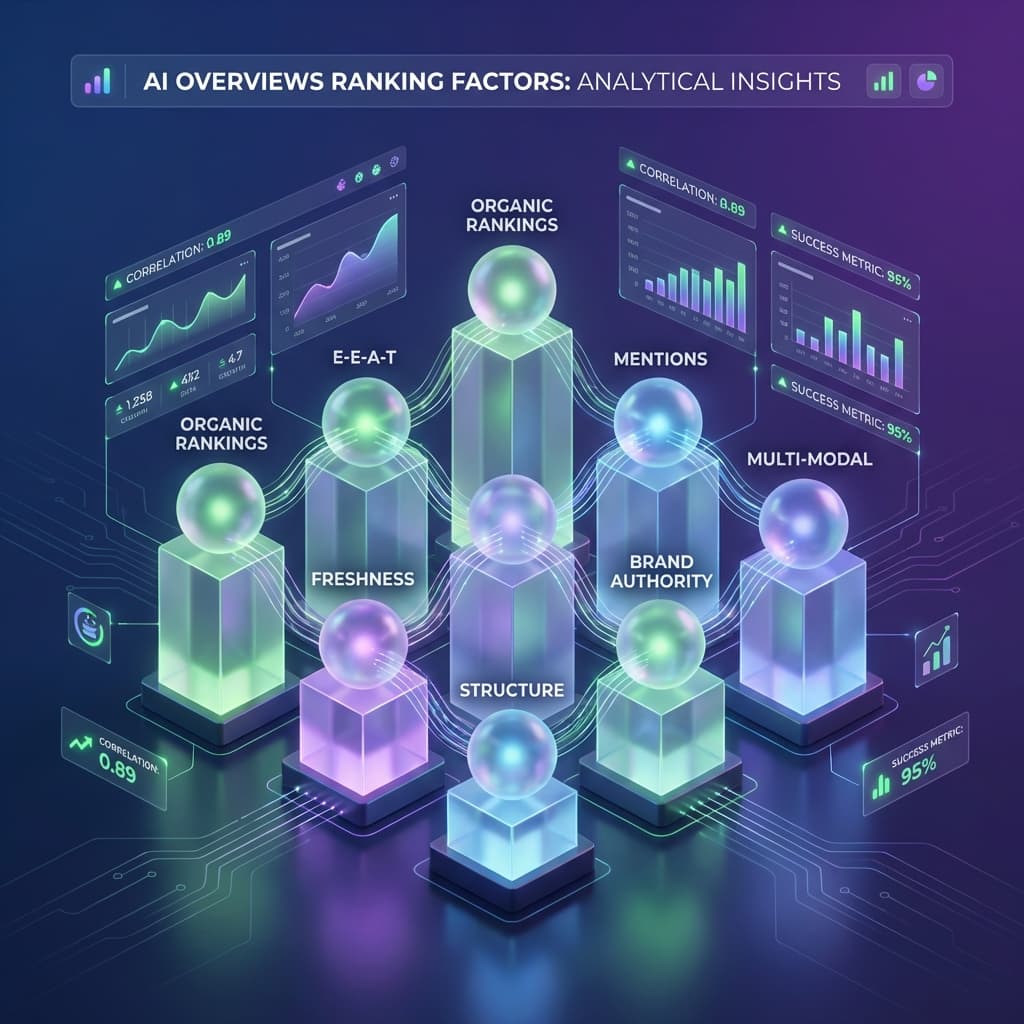
AI Search Ranking Factors: What Influences AI Recommendations in 2026
When ChatGPT recommends your competitor instead of you, or Perplexity cites a rival's blog post over yours, it's not random. AI search engines follow specific r
⚡ TL;DR
When ChatGPT recommends your competitor instead of you, or Perplexity cites a rival's blog post over yours, it's not random. AI search engines follow specific ranking factors when deciding which brands and content to recommend. Understanding these factors is the difference between AI visibility and
📑 Table of Contents
When ChatGPT recommends your competitor instead of you, or Perplexity cites a rival's blog post over yours, it's not random. AI search engines follow specific ranking factors when deciding which brands and content to recommend. Understanding these factors is the difference between AI visibility and AI invisibility.
Research analyzing 20,000+ ChatGPT citations reveals that certain content characteristics dramatically increase citation likelihood. Pages with First Contentful Paint (FCP) under 0.4 seconds are 3x more likely to be cited than those over 1.13 seconds. Long-form content over 2,900 words gets cited 59% more often than pages under 800 words.
This guide covers the ranking factors that matter across ChatGPT, Claude, Perplexity, and Google AI Overviews in 2026.
Understanding AI Search vs. Traditional Search#
AI search engines don't rank pages—they select sources to cite when generating answers. The difference is fundamental:
Traditional Search Ranking#
- Goal: Match query to relevant pages
- Output: List of ranked URLs
- User action: Click through to read
- Metrics: CTR, dwell time, bounce rate
AI Search Citation#
- Goal: Generate comprehensive answer
- Output: Synthesized response with citations
- User action: Read answer directly
- Metrics: Citation rate, position in response, recommendation strength
This shift means traditional SEO factors like keyword density matter less, while authority signals, content structure, and technical performance matter more.
Top 20 AI Search Ranking Factors#
Domain Authority Signals (High Impact)#
1. Domain Rating
Domain Rating correlates strongly with citation likelihood. High-authority domains get cited more frequently across all AI engines.
How to improve:
- Earn backlinks from authoritative sites
- Get featured in industry publications
- Build partnerships with established brands
- List in trusted directories (G2, Capterra for SaaS)
Impact Level: Critical for ChatGPT, High for Perplexity, Medium for Claude
2. Backlink Profile Quality
Not just quantity—AI engines prioritize sites with diverse, high-quality backlinks from relevant domains.
Key metrics:
- Referring domains from your industry
- Links from .edu and .gov sites
- Citations from news outlets
- Mentions in authoritative blogs
Tools: Use Ahrefs or Moz to audit your backlink profile
3. Brand Mentions (Unlinked)
Even without backlinks, brand mentions signal authority. When authoritative sites mention your brand name, AI engines take notice.
How to track:
- Google Alerts for your brand name
- Brand monitoring tools (Brand24, Mention)
- Track Share of Voice in your category
Content Quality Factors (Very High Impact)#
4. Content Length and Depth
Pages over 2,900 words are cited 59% more often than pages under 800 words.
Optimal ranges by content type:
- Guides: 2,000-4,000 words
- How-tos: 1,200-2,500 words
- Comparison pages: 1,500-3,000 words
- Product pages: 800-1,500 words
Depth matters more than length. Cover topics comprehensively with examples, data, and expert perspectives.
5. Flesch Readability Score
Readability correlates with citation likelihood. AI engines favor content that's easy to parse and understand.
Target scores:
- 60-70: Standard for most business content
- 70-80: Ideal for broader audiences
- 80+: Too simplistic for professional topics
Check readability: Hemingway Editor, Yoast SEO, or Grammarly
6. Structural Clarity (H2/H3 Hierarchy)
Clear heading structure helps AI engines extract specific facts to cite.
Best practices:
# Main Title (H1)
## Introduction
## Key Concept 1 (H2)
### Specific Detail (H3)
### Example (H3)
## Key Concept 2 (H2)
### Implementation (H3)
## Conclusion
AI engines can pull from specific sections when relevant to a query.
7. Factual Density
Content packed with specific facts, statistics, and data points gets cited more often than opinion-heavy content.
High factual density:
"According to Gartner's 2024 survey of 500 CMOs, 73% now allocate budget to AI visibility tracking, up from 12% in 2023."
Low factual density:
"Many companies are starting to care about AI search and are investing more in it."
How to increase:
- Include specific numbers and percentages
- Cite research studies
- Reference surveys and reports
- Add case study data
8. Content Freshness
Perplexity's real-time retrieval heavily weights recent content. Pages published or updated recently rank higher.
Strategies:
- Publish new content regularly
- Update existing pages with current data
- Add "Last updated: [date]" timestamps
- Refresh statistics annually
- Remove outdated information
Impact varies by engine:
- Perplexity: Very High (real-time search)
- Google AI Overviews: High (freshness signal)
- ChatGPT: Medium (training data cutoff)
- Claude: Low (parametric knowledge)
Technical Performance Factors (High Impact)#
9. Page Load Speed (First Contentful Paint)
Pages with FCP under 0.4s are 3x more likely to be cited than those over 1.13 seconds.
Optimization checklist:
- Use a CDN for static assets
- Optimize images (WebP format, proper sizing)
- Minimize JavaScript bundle size
- Enable browser caching
- Use lazy loading for below-fold content
Measure with: Google PageSpeed Insights, WebPageTest
10. Mobile Responsiveness
Mobile-first design is essential. AI engines test content on mobile devices when evaluating citation quality.
Requirements:
- Responsive layouts (not separate mobile URLs)
- Touch-friendly navigation
- Readable font sizes (16px minimum)
- Proper viewport meta tag
- Fast mobile load times
11. HTTPS and Security
Sites using HTTPS are strongly preferred. Security signals trust.
Must-haves:
- Valid SSL certificate
- No mixed content warnings
- Secure forms
- Updated security headers
12. Structured Data (Schema.org)
Schema markup helps AI engines understand and extract specific information.
High-value schemas:
- Article: For blog posts and guides
- HowTo: For tutorials and processes
- Product: For SaaS/product pages
- FAQPage: For FAQ sections
- Organization: For brand information
- SoftwareApplication: For software products
{
  "@context": "https://schema.org",
  "@type": "Article",
  "headline": "AI Search Ranking Factors",
  "author": {
    "@type": "Organization",
    "name": "Citedify"
  },
  "datePublished": "2026-01-23",
  "dateModified": "2026-01-23"
}
Content Format Factors (Medium Impact)#
13. Lists and Tables
Structured data formats (bullet lists, numbered steps, comparison tables) are easier for AI to parse and cite.
Effective formats:
- Comparison tables (features, pricing, specs)
- Step-by-step numbered lists
- Bulleted feature lists
- Pros/cons lists
- Checklists
14. FAQs
FAQ sections directly answer common questions—exactly what AI search queries are.
Best practices:
- Use H3 headings for each question
- Provide concise, factual answers
- Cover related questions comprehensively
- Implement FAQPage schema markup
15. Images and Visual Content
While AI engines can't "see" images yet, image alt text, captions, and surrounding context matter.
Optimization:
- Descriptive alt text with keywords
- Detailed image captions
- Context paragraphs explaining visuals
- Optimized file names (not IMG_1234.jpg)
Trust and Expertise Signals (Very High Impact)#
16. Author Expertise (E-E-A-T)
Google's Experience, Expertise, Authoritativeness, and Trustworthiness guidelines apply to AI search.
How to demonstrate E-E-A-T:
- Author bios with credentials
- Links to author social profiles
- Industry affiliations and certifications
- First-hand experience descriptions
- Expert quotes and interviews
17. Citations and References
Content that cites authoritative sources is more likely to be cited itself.
Best practices:
- Link to original research studies
- Reference industry reports
- Cite expert opinions
- Link to related authoritative content
- Use footnotes or inline citations
18. Review Signals (For Products/Services)
AI engines heavily weight G2, Capterra, and TrustRadius for SaaS recommendations.
Key platforms by industry:
- SaaS: G2, Capterra, TrustRadius
- E-commerce: Trustpilot, Reviews.io
- Local: Google Reviews, Yelp
- B2B Services: Clutch, UpCity
What matters:
- Review volume (100+ reviews signals legitimacy)
- Average rating (4.0+ minimum)
- Recent reviews (active engagement)
- Response rate (reply to reviews)
Content Relevance Factors (High Impact)#
19. Topical Authority
Sites known for specific topics get cited more for those topics.
Build topical authority:
- Publish comprehensive content clusters
- Cover topics from multiple angles
- Link related content internally
- Update content regularly
- Own a category or niche
Example: A site with 50 in-depth AI SEO articles will be cited more for AI SEO queries than a general marketing blog with 2 AI articles.
20. Query Intent Matching
Different query intents require different content approaches.
Intent types:
Informational ("What is GEO?")
- Comprehensive definitions
- How-it-works explanations
- Educational guides
Navigational ("Citedify pricing")
- Clear product information
- Transparent pricing
- Direct answers
Transactional ("Best AI SEO tool")
- Comparison content
- Feature breakdowns
- Pricing comparisons
- Review summaries
Commercial Investigation ("Citedify vs Semrush")
- Head-to-head comparisons
- Use case scenarios
- Pros/cons analysis
Platform-Specific Ranking Differences#
ChatGPT (OpenAI)#
Highest-weight factors:
- Domain authority and backlinks
- Content length (2,000+ words)
- Flesch readability score
- Structural clarity
- Page load speed
Unique considerations:
- Training data cutoff means recent content may not appear
- Web search feature (when enabled) prioritizes fresh, authoritative content
- Strong preference for .edu and .gov sources
Perplexity#
Highest-weight factors:
- Content freshness (real-time priority)
- Word count (1,200-1,800+ words)
- Sentence count
- Featured snippet optimization
- Citeable structure
Unique considerations:
- Real-time retrieval means your content can be cited the day you publish
- Less reliance on domain authority than ChatGPT
- Heavy focus on factual, well-structured content
Claude (Anthropic)#
Highest-weight factors:
- Authoritative, well-sourced content
- Factual accuracy
- Content depth
- Expert credentials
- Clear explanations
Unique considerations:
- Parametric knowledge (no real-time web search in base model)
- Strong preference for educational, explanatory content
- Values nuanced, balanced perspectives
Google AI Overviews#
Highest-weight factors:
- Traditional SEO fundamentals
- Featured snippet presence
- Structured data markup
- Page authority
- Mobile optimization
Unique considerations:
- Inherits ranking signals from traditional Google Search
- Featured snippets often become AI Overview citations
- Local pack integration for location-based queries
Measuring Your AI Ranking Performance#
Track these metrics to understand your AI visibility:
Citation Metrics#
- Mention Rate: % of relevant queries where you appear
- Position: Average ranking when mentioned (1st, 3rd, 7th)
- Recommendation Strength: Primary, alternative, or merely mentioned
- Share of Voice: Your citations vs. competitors
Quality Metrics#
- Sentiment: How AI describes you (positive, neutral, negative)
- Context: Featured as solution, mentioned as option, or compared to others
- Citation Source: Which of your pages get cited most
Competitive Metrics#
- Head-to-Head: Your position vs. specific competitors
- Category Ranking: Overall position in your category
- Emerging Threats: New competitors appearing in results
Recommended Tools: Citedify provides automated tracking across ChatGPT, Claude, Perplexity, and Google AI Overviews with all these metrics built-in.
Optimization Priorities: Where to Start#
If You're Starting from Zero#
Week 1-2: Foundation
- Audit current content length (aim for 1,500+ words on key pages)
- Improve page speed (target FCP < 0.4s)
- Add Schema.org markup to top pages
- Ensure mobile responsiveness
Week 3-4: Authority Building 5. Get listed on review sites (G2, Capterra, etc.) 6. Earn 5-10 high-quality backlinks 7. Publish 2-3 in-depth guides (2,000+ words) 8. Add FAQ sections to product pages
If You Have Strong SEO But Weak AI Visibility#
Focus on:
- Increasing content depth (double word counts)
- Adding structured data markup
- Improving factual density (more stats, data, citations)
- Creating comparison and alternative pages
- Publishing fresh content monthly
If You Have Weak Domain Authority#
Focus on:
- Publishing exceptional long-form content (3,000+ words)
- Getting listed in trusted directories
- Earning press mentions and reviews
- Optimizing for Perplexity (less authority-dependent)
- Building topical authority in a specific niche
Common Ranking Factor Mistakes#
❌ Keyword Stuffing#
AI engines detect and penalize unnatural keyword repetition.
Bad: "Best AI SEO tool for AI SEO optimization and AI SEO ranking" Good: "Comprehensive platform for optimizing your brand's visibility across AI search engines"
❌ Thin Content Pages#
Pages under 800 words are 59% less likely to be cited.
Fix: Expand or consolidate. Either make pages comprehensive (1,500+ words) or merge thin pages into pillar content.
❌ Slow Page Speed#
Every 0.1s delay in FCP reduces citation likelihood.
Fix: Run PageSpeed Insights, implement Core Web Vitals improvements.
❌ No Structured Data#
Missing Schema markup means AI engines must guess about your content type and structure.
Fix: Add Article, HowTo, Product, or FAQPage schema to key pages.
❌ Ignoring Mobile#
AI engines test content on mobile devices when evaluating quality.
Fix: Implement responsive design, test on real mobile devices.
The Future of AI Ranking Factors#
Expect these trends in 2026-2027:
- Multimodal Signals - AI engines analyzing images, videos, and audio content
- User Engagement Data - Click-through rates from AI citations influencing future rankings
- Real-Time Updates - More platforms adopting Perplexity-style real-time retrieval
- Personalization - AI responses tailored to user context and preferences
- Voice Optimization - Ranking factors for voice-based AI queries
Conclusion#
AI search ranking factors differ from traditional SEO but follow predictable patterns. Domain authority, content depth, technical performance, and trust signals matter most across all platforms.
The brands winning in AI search are those systematically optimizing for these factors while continuously monitoring their AI visibility. Start with the highest-impact improvements—page speed, content length, structured data—then iterate based on what drives citations in your category.
Remember: AI ranking factors will evolve as models improve. The fundamentals (authority, quality, performance, trust) remain constant.
Want to see how your content performs against these ranking factors? Citedify's AI visibility audit analyzes your pages across ChatGPT, Claude, Perplexity, and Google AI Overviews—identifying exactly which factors are helping or hurting your citations.
Sources#
Ready to Improve Your AI Visibility?
Track how often your brand appears in ChatGPT, Perplexity, Claude, and Google AI. Get insights on where you're cited and where you're missing.
Get Your Audit Report