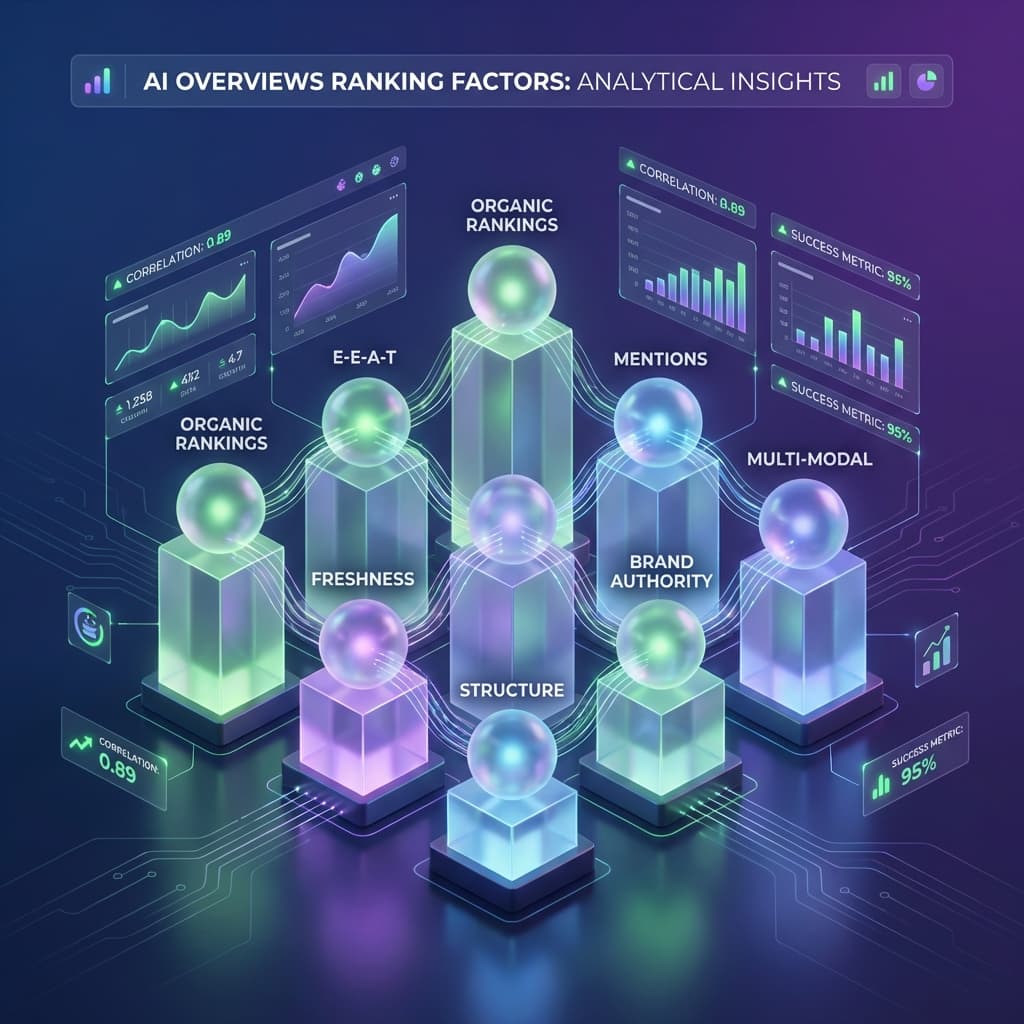
The 7 factors that determine AI Overview citations: organic rankings (86% from top 100), E-E-A-T signals (r=0.81 correlation), content freshness (85% from last 2 years), structured format (+47% for tables), third-party mentions (85% of citations), brand authority (3x more valuable than backlinks), and multi-modal content (+156% selection rate).
Traditional SEO metrics like Domain Authority (r=0.18) and backlink volume (r=0.37) barely correlate with AI citations. Here's what actually determines whether AI cites your content—based on analysis of 36 million AI Overviews.
The Great Disconnect: Why Traditional SEO Metrics Fail
Before diving into what works, understand what doesn't.
Research analyzing 8,000 AI citations found that 28% of ChatGPT's most-cited pages have zero organic visibility in Google search. When ChatGPT does cite webpages, those pages rank in positions 21+ for related queries almost 90% of the time.
| Traditional SEO Metric | Correlation with AI Citations |
|---|---|
| Domain Authority | r=0.18 (weak) |
| Backlink Volume | r=0.37 (moderate at best) |
| Brand Web Mentions | r=0.664 (strong) |
The paradox: traditional authority signals create a threshold effect rather than a linear correlation. Sites must reach a baseline authority level to be eligible for citations, but beyond that threshold, other factors dominate.
Getting mentioned is now 3x more valuable than getting a link.
Not sure where you stand? Check your AI visibility score and see which factors are working for-or against-your brand.
Factor 1: Organic Search Rankings (The Foundation)
Data Point: 86% of AI Overview citations come from pages ranking somewhere in Google's top 100.
This is the most misunderstood factor. You can't shortcut around traditional SEO to win in AI Overviews-organic rankings are the foundation everything else builds on.
The median cited URL ranks position 3 in traditional search results. If you rank first on Google, your chances of appearing in AI Overviews jump to 33.07%-nearly doubling visibility compared to just being somewhere in the top 10.
What This Means for Your Strategy
Priority 1: Audit your current rankings
- Which keywords do you rank top 10 for?
- Which of those trigger AI Overviews?
- Where are the overlap opportunities?
Priority 2: Fix traditional SEO gaps
- Page speed and Core Web Vitals
- Mobile optimization
- Internal linking structure
- Backlink quality (not just quantity)
Priority 3: Target realistic keywords
- Don't chase keywords where you're page 3
- Focus on keywords where you can reach top 10 within 6 months
- Layer AI optimization on top of organic success
The Position Breakdown
| Organic Position | AI Overview Citation Rate |
|---|---|
| Position 1 | 33.07% |
| Positions 2-10 | ~17% average |
| Positions 11-100 | Significantly lower |
| Positions 100+ | Rare (14% of citations) |
Read the complete guide: Google AI Overviews 2026: What SEOs Must Know
Factor 2: E-E-A-T Signals (The Gating Mechanism)
Data Point: E-E-A-T shows r=0.81 correlation with AI citations. 96% of AI Overview content comes from sources with verified E-E-A-T signals.
E-E-A-T has evolved from a quality rater guideline into a ranking filter. Content lacking clear Experience, Expertise, Authoritativeness, and Trust signals increasingly fails to earn citations.
Pages with expert authorship are 3.2x more likely to be cited than general staff-written content.
The E-E-A-T Framework for AI Citations
Experience (First-Hand Knowledge)
- Original case studies from actual implementations
- Data from your own research or customer base
- Screenshots, recordings, or artifacts from real usage
- Personal insights from hands-on work
- Customer testimonials with verifiable details
Expertise (Demonstrated Knowledge)
- Author bylines with credentials and background
- Technical depth showing subject mastery
- Industry-specific terminology used correctly
- Citations of relevant research and primary sources
- Track record of published work in the domain
Authoritativeness (Recognition as a Source)
- Wikipedia presence for company or individuals
- Citations by other authoritative sources
- Speaking engagements, publications, awards
- Industry certifications or academic credentials
- Media appearances and press coverage
Trust (Reliability and Transparency)
- Clear sourcing for all factual claims
- Contact information and company details
- Privacy policy and terms of service
- Secure site (HTTPS)
- Accurate, consistent information across the web
Implementation Checklist
- Add detailed author bios with credentials
- Include "About the Author" sections on all content
- Cite primary sources for all factual claims
- Add "Last Updated" dates (with real updates)
- Include original data, research, or case studies
- Ensure Wikipedia presence for company/key people
- Display trust signals (certifications, awards, press)
Want to see your E-E-A-T gaps? Run an AI visibility audit to identify exactly where your authority signals are weak.
Factor 3: Content Freshness (The Recency Bias)
Data Point: AI-cited content is 25.7% fresher than organic Google results. 85% of citations come from content published in the last 2 years.
AI platforms have a strong recency bias. ChatGPT shows the strongest preference, with 76.4% of most-cited pages updated within the last 30 days.
Freshness by Platform
| Platform | Freshness Preference |
|---|---|
| ChatGPT | 76.4% from last 30 days |
| Google AI Overviews | 23% less than 30 days old |
| Perplexity | Real-time crawling priority |
| Claude | 30-60 day window |
The Fake Freshness Penalty
Google's December 2025 core update refined how it evaluates content freshness. Sites that simply change published dates without meaningful content updates receive:
- Trustworthiness signal reductions
- Ranking demotions
- Potential manual actions for repeated offenses
What "fresh" actually means:
- New statistics and data points
- Updated examples and case studies
- Additional sections addressing new questions
- Revised recommendations based on recent developments
- Current year references with substance behind them
Content Refresh Schedule
Monthly:
- Update statistics and data points
- Add recent news and developments
- Check for outdated information
Quarterly:
- Refresh examples and screenshots
- Update competitor comparisons
- Add new FAQ questions
- Review and expand sections
Annually:
- Full content audit
- Structure and format refresh
- Comprehensive data update
- New case studies
Factor 4: Structured Content Format (The Extraction Factor)
Data Point: Pages with comparison tables show 47% higher citation rates. FAQPage markup increases AI Overview appearance by 3.2x.
AI systems prefer scannable, well-structured content they can easily extract and cite. Dense paragraphs and missing headers make content invisible to AI.
High-Citation Content Elements
Headers (H2/H3 Hierarchy)
- Clear, descriptive section titles
- Logical information architecture
- Keywords in headers (natural placement)
- Consistent hierarchy throughout
Lists and Tables
- Numbered lists for processes and rankings
- Bulleted lists for features and benefits
- Comparison tables for alternatives
- Data tables for statistics
Definition Sections
- "What is [term]" headers
- Clear, concise definitions (30-50 words)
- Use "Definition:" headers for AI extraction
FAQ Sections
- Schema markup implementation
- Concise questions (15 words/80 characters)
- Direct answers (30-50 words)
- Based on real PAA questions
Schema Markup Implementation
Though Google restricted FAQ rich results in August 2023, AI platforms actively use FAQ schema for citation:
{
  "@context": "https://schema.org",
  "@type": "FAQPage",
  "mainEntity": [{
    "@type": "Question",
    "name": "What are the top AI Overview ranking factors?",
    "acceptedAnswer": {
      "@type": "Answer",
      "text": "The top factors are: organic rankings (86% from top 100), E-E-A-T signals (r=0.81 correlation), content freshness (85% from last 2 years), structured format, third-party mentions, brand authority, and multi-modal content."
    }
  }]
}
Additional schema types to implement:
- Article schema (for blog posts)
- Organization schema (for about pages)
- HowTo schema (for tutorials-though rich results removed)
- Product schema (for product pages)
Factor 5: Third-Party Mentions (The Off-Site Signal)
Data Point: 85% of AI citations come from third-party sources, not owned content. Brands in the top 25% for web mentions earn 10x more AI Overview citations.
This is the most underutilized factor. Most SEOs obsess over their own content while ignoring the off-site signals that drive most citations.
Citation Sources by Journey Stage
| Stage | Third-Party | User-Generated | Owned Content |
|---|---|---|---|
| Discovery | 78% | 12% | 10% |
| Evaluation | 52% | 31% | 17% |
| Decision | 34% | 28% | 38% |
For top-of-funnel queries, you're 6.5x more likely to get cited from third-party content than your own domain.
Where to Build Third-Party Presence
Wikipedia (Critical)
- ChatGPT cites Wikipedia in 47.9% of top citations
- Create/update company page
- Ensure key people have entries
- Add neutral, well-sourced information
Reddit (Growing Importance)
- Perplexity cites Reddit in 46.7% of responses
- Google AI Overviews cite Reddit in 21% of results
- Engage authentically (not promotional spam)
- Build reputation in relevant subreddits
YouTube
- 23.3% of AI Overview citations
- 18.8% of Google's AI citations
- Create educational content
- Optimize titles and descriptions for search
Review Platforms
- G2, Capterra, TrustRadius for B2B
- Yelp, Google Reviews for local
- Industry-specific review sites
- Encourage genuine customer reviews
Industry Publications
- Guest posts on authoritative sites
- Press releases and news coverage
- Expert commentary and quotes
- Research partnerships
Check your third-party presence: Get your AI visibility score to see how you're being mentioned across the web.
Factor 6: Brand Authority Signals (The New SEO Metric)
Data Point: Brand web mentions show 0.664 correlation with AI visibility. Backlinks show just 0.218. Mentions are 3x more valuable than links.
Brand search volume has become the strongest single predictor of AI citations, surpassing backlinks as the authority signal that matters.
Brand Authority by the Numbers
| Brand Search Volume | AI Citation Frequency |
|---|---|
| 5,000+ monthly | 4.2x baseline |
| 1,000-4,999 | 2.1x baseline |
| 500-999 | 1.3x baseline |
| Under 500 | Baseline |
Companies with 5,000+ monthly brand searches get cited 4.2x more frequently than those under 500-even when controlling for backlink profiles.
Building Brand Authority
Increase Brand Search Volume:
- Brand awareness campaigns
- Thought leadership content
- Conference speaking
- Podcast appearances
- Original research publications
Earn Brand Mentions:
- PR and media outreach
- Industry analyst briefings
- Partnership announcements
- Award submissions
- Community engagement
Create Share-Worthy Content:
- Original data and research
- Tools and calculators
- Templates and frameworks
- Industry benchmarks
Measuring Brand Authority
Track these metrics monthly:
- Branded search volume (Google Keyword Planner)
- Brand mention volume (social listening tools)
- Direct traffic growth
- Share of voice in your category
Factor 7: Multi-Modal Content (The Selection Multiplier)
Data Point: Multi-modal content (text + images + video + structured data) shows 156% higher selection rates compared to text-only content.
AI systems prefer content that combines multiple formats. Text-only pages are increasingly disadvantaged.
Multi-Modal Content Elements
Visual Content:
- Original images and diagrams
- Data visualizations and charts
- Screenshots and examples
- Infographics
Video Content:
- Embedded explanatory videos
- Video summaries of written content
- Tutorial walkthroughs
- Expert interviews
Structured Data:
- Schema markup (FAQ, Article, HowTo, Organization)
- Tables and comparison charts
- Step-by-step numbered lists
- Definition blocks
Interactive Elements:
- Calculators and tools
- Quizzes and assessments
- Configurators
- Embedded applications
Implementation Priority
- Add schema markup to all key pages (highest ROI)
- Create data visualizations for statistics-heavy content
- Embed relevant videos or create video summaries
- Build original diagrams explaining complex concepts
- Develop interactive tools for high-value topics
Putting It All Together: The Ranking Factor Framework
The Citation Eligibility Stack
Layer 1: Organic Rankings (Foundation)
├── Must rank top 100 (ideally top 10)
├── 86% of citations come from here
└── No shortcut around this

Layer 2: E-E-A-T Signals (Gating)
├── 96% of citations have verified E-E-A-T
├── Expert authorship = 3.2x more likely
└── Wikipedia presence critical

Layer 3: Content Quality (Selection)
├── Freshness (85% from last 2 years)
├── Structure (tables = +47%)
├── Multi-modal (+156%)
└── FAQ schema (3.2x more likely)

Layer 4: Off-Site Signals (Amplification)
├── Third-party mentions (85% of citations)
├── Brand authority (3x more than links)
└── Platform presence (Reddit, YouTube, Wikipedia)
Audit Your Current State
Score yourself on each factor (1-5):
| Factor | Your Score | Priority |
|---|---|---|
| Organic Rankings | ___ /5 | Foundation |
| E-E-A-T Signals | ___ /5 | High |
| Content Freshness | ___ /5 | High |
| Content Structure | ___ /5 | Medium |
| Third-Party Mentions | ___ /5 | High |
| Brand Authority | ___ /5 | Long-term |
| Multi-Modal Content | ___ /5 | Medium |
Total: ___ /35
- 28-35: Strong position, optimize incrementally
- 21-27: Good foundation, address gaps
- 14-20: Significant work needed
- Under 14: Start with fundamentals
Frequently Asked Questions
What is the most important ranking factor for AI Overviews?
Organic search rankings are the foundation-86% of citations come from pages ranking in Google's top 100, with the median cited URL at position 3. However, E-E-A-T signals (r=0.81 correlation) act as the gating mechanism that determines whether ranked pages get cited.
Do backlinks still matter for AI Overviews?
Backlinks show only r=0.37 correlation with AI citations, while brand mentions show r=0.664. Getting mentioned is now 3x more valuable than getting a link. Backlinks still help organic rankings (which are foundational), but for AI-specific optimization, focus on brand mentions.
How fresh does content need to be?
85% of AI citations come from content published in the last 2 years, and 44% from the current year. ChatGPT shows the strongest recency preference, with 76.4% of citations from pages updated in the last 30 days. Update key content at least quarterly.
Does FAQ schema still work for AI Overviews?
Yes. Pages with FAQPage markup are 3.2x more likely to appear in Google AI Overviews. Though Google restricted FAQ rich results in August 2023, AI platforms actively use FAQ schema for citation extraction.
How do I improve my E-E-A-T signals?
Add author bylines with verifiable credentials, include original research and first-hand experience, cite primary sources, maintain Wikipedia presence, and ensure consistent accurate information across the web. Expert authorship makes pages 3.2x more likely to be cited.
Your Action Plan
This Week
- Audit organic rankings - Identify keywords where you rank top 10 that trigger AI Overviews
- Check E-E-A-T signals - Review author bios, credentials, and source citations
- Assess content freshness - Flag content not updated in 6+ months
This Month
- Implement FAQ schema on top 10 pages
- Update stale content with fresh data and examples
- Add author credentials and bylines site-wide
- Audit third-party presence on Wikipedia, Reddit, review sites
This Quarter
- Build brand awareness campaigns
- Create original research or data studies
- Develop multi-modal content strategy
- Establish industry publication relationships
Ready to see your ranking factor scores? Get your AI visibility audit and discover exactly where to focus your optimization efforts.
Continue the series: